

Vision: Viable runs of native Lake Washington Basin kokanee in McAleer and Lyon Creeks by 2026
See a salmon? Interested in looking for or hearing about salmon? Check out Salmon Watchers
Background
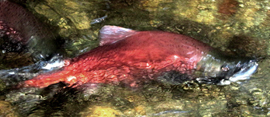 Lake Forest Park, like many towns in the west, has stories of the olden days in which salmon were stacked like cordwood in local streams. Our streams have a special distinction in having had an abundance of kokanee salmon, remembered as “the plentiful Little Red Fish that were unique to the area.” (1). Kokanee salmon are a variety of the better known Sockeye salmon that have become landlocked – their entire life cycle takes place in fresh water. After emerging from the gravel in March and April, kokanee fry quickly move downstream and usually spend two-and-a-half years in a large lake before returning to spawn in their stream of origin in the Fall. Kokanee have evolved multiple times in different places, usually in cases where glaciers or shallow wetlands have blocked access to the ocean. In the Lake Washington/Sammamish basin there were at least three distinct runs – an “early” run and “late” run found in Lake Sammamish, and a “middle-run” found in many tributaries of the Sammamish river and Lake Washington – including McAleer and Lyons creeks. In Lake Sammamish the “early” run was declared extinct around 2000, and the “late” run has been the focus of intense and successful restoration efforts involving local, state, federal, and tribal programs (more info here (2)). The Lake Washington “middle” run, which includes the kokanee that once spawned in Lyon and McAleer Creeks, was considered by most biologists to have disappeared by the 1990’s.
The emerging science of Lake Washington kokanee
The situation for Lake Washington kokanee is complicated because kokanee population sizes are highly variable, there is the possibility that our local kokanee have interbred with sockeye or kokanee populations introduced from elsewhere, and sockeye occasionally produce individuals that don’t bother to go out to sea (these are called “residuals” to distinguish them from true kokanee). Early genetic work indicated that the kokanee-like fish occasionally seen in local streams were actually residual sockeye and not our native kokanee.
In 2011 a mysterious and very large run of kokanee-like fish appeared in the Sammamish River and North Creek in Bothell (and a few in May Creek in Renton). This drew interest, but not much follow-up until another large run appeared in 2017. Subsequent research has revealed this population (and runs in 2020, 2022, 2023):
- Is genetically distinct from Lake Washington sockeye populations, i.e. NOT residual sockeye
- Does not migrate to the ocean, and does not come from mothers that migrated to the ocean, i.e. consistently shows a typical kokanee life cycle
- Returns later than sockeye/residuals so has limited opportunity to interbreed with sockeye
- Runs primarily on a three-year cycle. Since these fish spawn primarily at age 3, this means the population is composed mostly of a single year class, with few or no kokanee spawning in between
- Most closely related to native Lake Sammamish kokanee, after genetic comparison to over 40 O. nerka populations throughout the Pacific Northwest.
What does this all mean? Native Lake Washington kokanee survive after all! For a deeper dive, look here.(3)
Native kokanee restoration and Lake Forest Park
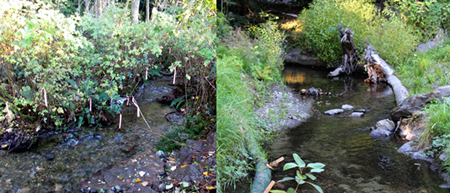 The LFPSF supports kokanee restoration efforts in Lyons and McAleer creeks. These creeks are excellent candidates for kokanee restoration for a variety of reasons, including:
- There are very few salmon in these streams now to compete with or complicate kokanee restoration
- The streams are small, and the portions of both streams pass through public/city property that allows easy access for monitoring
- There have recently been a major culvert restorations (e.g. under 522, SR104) and habitat restoration creating quite a bit of accessible spawning habitat.
- Although it arises in Snohomish county, most of the relevant habitat is in King county and is, in fact, within the single municipality of Lake Forest Park so municipal and community engagement would be streamlined.
- There is a very active community environmental community in Lake Forest Park, with a track record of fundraising, advocacy, environmental permitting and restoration, habitat monitoring and volunteerism
- Relative to most urban/suburban streams, the McAleer and Lyons creeks watersheds have an extensive tree canopy
Progress and Current Status
Permitting of salmon restoration is complicated. We envision restoration occurring in three phases:
- Phase 1 (4-6 years): Documenting the origin and status of North Lake Washington kokanee populations and assessing the suitability of Lyons and McAleer creeks as kokanee spawning habitat. This is completed.
- Phase 2 (4-6 years): Supplementation of kokanee populations through some combination of stream enhancement, egg box rearing, hatchery rearing, introduction of fry. Plans have been developed, source populations for eggs have been identified, and partners and locations for deploying egg boxes have been identified. Currently (March, 2026) permitting is underway with the goal to harvest eggs and sperm for reintroduction to LFP streams in Fall 2026.
- Phase 3 (ongoing, starting Fall 2029): Monitoring of returning adult numbers (see Salmon Watchers) and egg-fry survival to assess conditions and impacts of streams and Lake Washington on kokanee growth and survival.
The successful efforts of the Lake Sammamish Kokanee working group (4) and the Three Rivers Chapter of Trout Unlimited (5) serve as an excellent model for our restoration plans. We have discussions underway with the Kokanee Working group, county, state, federal, and UW fisheries biologists, local environmental organizations that share our interest in restoring middle-run kokanee (e.g. PERK, Friends of North Creek Forest), LFP citizens, and environmental stewards who have long been active in our community (e.g. Streamkeepers).
How you can help!
- If you share our interest in returning our “little red fish” please share your interest with your neighbors, your local government, and with us!
- If you own property along the stream and are will to allow access to survey the stream, let us know! We’ll be sensitive of and respectful to your property.
- If you see a salmon in our streams, let us know by reporting it on the Salmon Watchers reporting web site! Stream monitoring is a time consuming and difficult process. The more eyes we have on the stream, the better. Pictures and complete descriptions are great, but even information about a salmon that you glimpse but can’t identify is useful.
- If you see something occurring that might impact salmon, or stream health more generally, please report it to the city and/or the Lake Forest Park Stewardship Foundation. These can include obvious things like pollution or construction activities along the stream, or less obvious but still important impacts such as excessive or unpermitted tree removal.
References
1. Barbara L. Drake Bender 1983. Growing up with Lake Forest Park : the early decades in “North Seattle” Edmonds, WA : Creative Communications. Contains a wealth of recollections of life in early LFP, including multiple references to kokanee.
2. Lake Sammamish Urban Wildlife Refuge Partnership. Great work and great outreach and engagement with the community around Lake Sammamish. https://www.lakesammamishrefuge.org/kokanee
3. Jensen, Jeffrey S. 2026. Genetic and life history evidence for the persistence of Native Lake Washington kokanee. Lake Washington Basin Science Summit. Sponsored by the USGS Western Fisheries Research Center (WFRC), the Lake Washington/Cedar/Sammamish Watershed (WRIA 8) Salmon Recovery Council and King County. January 21-22, 2026. Seattle Washington.
4. The Lake Sammamish Kokanee Workgroup. http://www.kingcounty.gov/environment/animals-and-plants/salmon-and-trout/kokanee/kokanee-workgroup.aspx. Tons of great partnerships and information in here.
5. Three Rivers Chapter of Trout Unlimited. They have been very active in Lake Sammamish Kokanee restoration science and monitoring for over 20 years. https://www.threeriverstu.org
Photo Information.
- Header image:Sockeye salmon in McAleer Creek, 2004.
- Kokanee spawning in Ebright Creek, Lake Sammamish watershed, 2015. Photo credit: Jeffrey S. Jensen
- Flagging tape marks the location of redds (spawning sites) of kokanee salmon in Ebright Creek (on left), a creek similar in size to Lyon Creek (on right). Photo credits: Jeffrey S. Jensen
 Lake Forest Park Stewardship Foundation