
StreamKeepers is a project of the LFP Stewardship Foundation
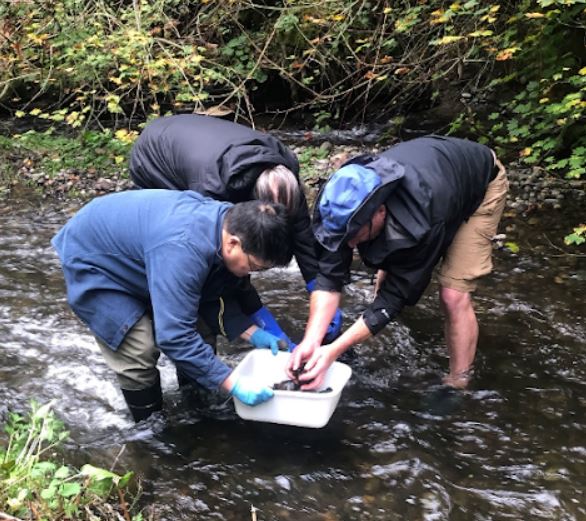
The Lake Forest Park StreamKeepers is a group of volunteers who keep an eye on stream quality and help educate on proper care to ensure continuing health and improvement to the quality of the streams within the City and McAleer/Lyon creek watershed in Lake Forest Park, Washington. We conduct regular stream testing, including chemical, fecal coliform, and biological integrity (BIBI). Last year we published a report in the Shoreline Area News that outlined the overall health of both Lyon and McAleer Creeks (https://www.shorelineareanews.com/2022/02/lake-forest-park-tale-of-two-creeks.html)
Interested in knowing how healthy our creeks in Lake Forest Park are? Check out our new interactive map that provides data and graphs from the locations the Streamkeepers are sampling.
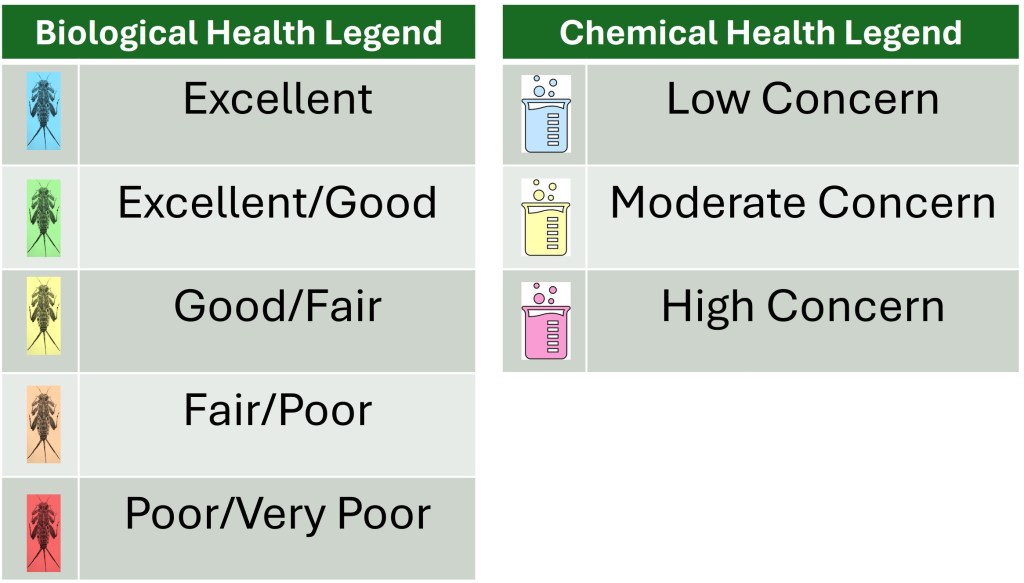
Stream Health Legend
Have you seen the Streamkeepers NEW logo? Ask us about it….its quite significant!

Streamkeepers, Stewardship Foundation, Awarded King County WaterWorks Grant!
In November of 2023, Lake Forest Park Stewardship Foundation was awarded a generous grant from King County WaterWorks program, to expand our assessment of the many small creeks and tributaries that feed into McAleer and Lyon Creek. The purpose of the grant is to fine-tune our water quality analysis and pinpoint what areas are the most susceptible to environmental degradation and identify possible sources. To find out more about the grant and what will be involved in our assessment, click on the following link (WQ Assessment). The Stewardship Foundation and members of the Streamkeeper team would like to thank Dow Constantine and the entire WaterWorks Grant Committee for their recognition of the value for civic engagement and public outreach in protecting our natural resources!
In November of 2024, we used part of our grant to analyze stream samples for eDNA (Environmental DNA) at six different locations on Lyon and McAleer Creeks. Environmental DNA (eDNA) refers to genetic material gathered from environmental sources like soil, streams, snow, or air, rather than being directly obtained from a specific organism. As organisms interact with their surroundings, they release DNA into the environment through various means, where it accumulates over time. This eDNA can be analyzed using environmental omics techniques to uncover information about the species present in an ecosystem, including microscopic organisms that may otherwise go unnoticed or be undetectable. The samples were process by Nature Metrics.
The map below shows our sample sites with a link to a table that provides a list of all the species detected in each sample. Where a species was detected in a sample, the percentage of DNA sequences assigned to that species is provided. A dash indicates that the species was not detected in the sample. The list includes fish species as well as some other vertebrates including birds, deer, squirrels and beavers.
Heavy metals were also tested in December of 2024 by collecting samples at six locations selected so that we could begin to understand how smaller tributaries feeding into the main Lyon and McAleer Creeks affected the overall heavy metal load. The two heavy metals we tested for were Copper (Cu) and Zinc (Zn) because these have abundant sources and historically have shown to be the most toxic to aquatic life in Lake Forest Park. Samples were processed by AT Test, Inc.
To learn more about heavy metal sources, how they are detected and how they are transported through ecosystems, click here to access the King County, Stream Database website.
Selected the sites on the map above to show the latest Copper (Cu) and Zinc (Zn) levels in micrograms per liter. Water quality criteria include acute and chronic compliance points. Chronic toxicity refers to long-term effects leading to death or impaired function, while acute toxicity results in death from short-term exposure.
According to available research, the acute toxic level of copper for salmon in freshwater is generally considered to be around 10-20 micrograms per liter (µg/L) in soft water, while chronic toxicity can occur at levels as low as 5 µg/L, with sensitive salmon species potentially experiencing effects at even lower concentrations; however, the exact levels can vary depending on water quality factors like hardness and the life stage of the salmon.
The acute and chronic toxic levels of zinc on salmon in freshwater depend on several factors, including water hardness, pH, and the age of the fish. In general, he EPA recommends that the 24-hour average concentration of zinc in freshwater should not exceed 47 µg/L.
For More Articles on StreamKeeper Activites
- SAN July 2021, https://www.shorelineareanews.com/2021/07/streamkeepers-joins-stewardship.html
- SAN September 2021, https://www.shorelineareanews.com/2021/09/lfp-streamkeepers-tracking-health-of.html
- SAN October 2021, https://www.shorelineareanews.com/2021/10/lfp-streamkeepers-team-up-with-lfp.html
- SAN January 2024, https://www.shorelineareanews.com/2024/01/the-untold-story-of-bschetla-creek.html
Streamkeepers Mission
– Encourage and facilitate public involvement in stream monitoring, watershed stewardship and stream restoration to support salmon and trout.
– To provide useful, credible data to the City of Lake Forest Park and to other natural resource planners acting to protect and restore the streams of Lake Forest Park.
– Report the information collected, on a regular and timely basis to the City of Lake Forest Park, to fellow volunteers, to the citizens of Lake Forest Park and to other interested agencies and organizations.
For more information or to join us, contact LFPSF Board member Brian Saunders
LATEST STORIES
Subscribe
Sign up for a weekly newsletter with the latest blog posts and exclusive content. In your inbox every Tuesday!
 Lake Forest Park Stewardship Foundation